
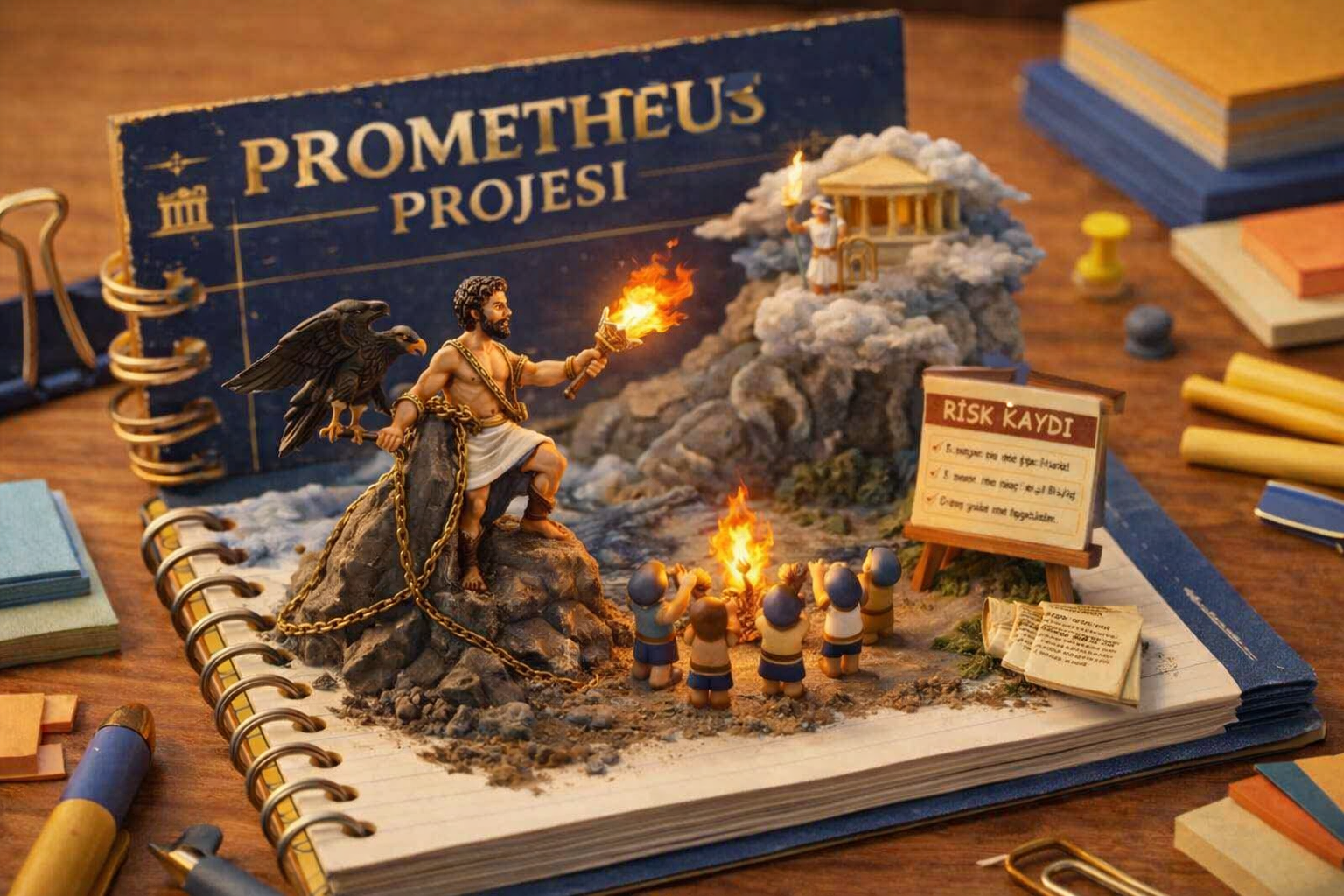
PM Canvas Series · The Prometheus Project · 15 min read
He did not ask for permission. He asked what humanity needed. Then he moved.
The project was never supposed to succeed.
Prometheus knew what he was carrying. He knew who owned it. He knew what the response would be when they found out.
He moved anyway.
This is not a story about rebellion. It is a story about the specific cost of delivering something the existing system has decided you are not allowed to deliver. Every organisation has a Prometheus. Most of them are chained to a rock right now, and the organisation is calling it a performance review.
The Prometheus Project is not a metaphor. It is a PM debrief.
Identity and Governance
Project Manager: Prometheus, Titan and benefactor of humanity.
Sponsor: Zeus, King of Olympus. Interests: system preservation, hierarchy maintenance, monopoly on transformative capability.
Executing Team: Humanity. Unaware they were the beneficiary. No involvement in charter.
Duration: One night. Consequences: eternal.
Status: Delivered. Agent imprisoned indefinitely. Project governance: catastrophic.
The first governance failure was structural. The sponsor and the project manager had fundamentally misaligned definitions of success. Zeus defined success as continuity of the existing order. Prometheus defined success as the delivery of capability to those who needed it most.
This is not a communication problem. This is a values problem. And values problems do not resolve through better stakeholder management.
Part 1: Initiating — The Unauthorised Charter
Every transformation project begins with a decision that someone made before the charter was signed.
Prometheus did not receive a mandate. He identified a need, assessed the gap between what existed and what was possible, and initiated without authorisation. The charter was written in retrospect, by fire.
In organisational change management, this is the most dangerous and most necessary moment: the point at which the change agent decides that the cost of inaction exceeds the cost of acting without permission.
Kotter calls this creating urgency. Lewin calls it unfreezing. Mytholagile calls it the Kairos decision — the moment when the window is open and waiting for authorisation means the window closes.
Prometheus did not wait. He moved at the precise moment the conditions allowed. The fire was already there. The gap was visible. The need was undeniable.
The initiating event was not the theft. It was the decision to prioritise delivery over personal survival.
The leader accepts the mandate knowing the personal cost. That acceptance is the true initiating event.
Part 2: Planning — What the Existing System Cannot Plan For
Prometheus planned for the delivery. He did not plan for the aftermath.
This is the planning paradox of every radical change initiative. You can map the route to delivery with precision. You cannot map the institutional response to something the institution never agreed to. Risk registers are built from precedent. Prometheus had no precedent. No one had stolen fire before.
The risk register had entries, all of which were logged as unresolvable: Divine retribution — certain, catastrophic, no mitigation identified. Isolation from formation — confirmed, high, accepted. Perpetual punishment cycle — certain, fatal, unresolved at planning stage. Career and reputation damage — high, high, accepted. Change reversal (Eagle Effect) — high, high, continuous monitoring.
He proceeded anyway. Not because the risks were manageable. Because the alternative — a world without fire — was a worse outcome than any risk on the register.
This is the planning posture of the genuine change agent: full awareness of the cost, full commitment to delivery, zero illusion about what comes next.
The Revolutionary archetype carries the passion to make the organisation a better place and the courage to break norms and challenge authority. But the greatest fear is real: finding herself at the other side of the barricades. Becoming establishment. Prometheus never became establishment. He paid a different price.
Part 3: Executing — The Delivery
The execution was Kairos-perfect.
One night. One move. The fire was taken from the forge of Hephaestus while the gods were occupied. No team. No announcement. No pilot programme. No change readiness assessment.
This is not a recommendation. It is a description of what radical transformation delivery looks like when the existing system has no interest in enabling it.
In conventional change management, execution requires sponsorship, coalition building, visible quick wins, and communication planning. Kotter’s eight steps. ADKAR’s awareness before desire. These frameworks assume a sponsor who wants the change to succeed.
Prometheus had a hostile sponsor. Zeus was not misaligned. He was opposed. The change was not underfunded. It was forbidden.
When the sponsor is the obstacle, the change agent cannot execute through the system. They execute around it, or they do not execute at all.
Three execution principles emerge from the Prometheus debrief:
Minimum viable delivery. The goal was fire in human hands, not a fire management system, a fire governance framework, or a fire adoption programme. Deliver the capability. Let humanity figure out the application.
Speed over consensus. Consensus requires access to decision makers who share your definition of success. Prometheus had none. Speed was the only strategy available.
Accept the cost before you move. The change agent who has not fully internalised the pioneer cost will hesitate at the moment of delivery. Hesitation is what gets you caught.
Part 4: Monitoring and Controlling — The Eagle Returns Every Morning
The punishment of Prometheus is the most precise description of institutional resistance ever recorded.
Each day, an eagle came and ate his liver. Each night, the liver regenerated. Each morning, the eagle returned.
This is not torture. This is a system defending itself against a change it cannot undo.
The organisation that has been transformed by a change agent it did not authorise will find ways to re-establish the previous equilibrium. The Agile transformation that quietly reverts to waterfall. The flat structure that grows back its hierarchy. The innovation lab that is reabsorbed into the business unit that was disrupting. The eagle returns every morning.
Monitoring and controlling in a hostile environment is not about tracking progress. It is about recognising that progress will be contested, repeatedly, by forces that have structural incentives to reverse it.
The change agent who survives this phase has one asset that the institution does not: the knowledge that the fire has already been delivered. Humanity already has it. You cannot un-give fire.
Control is not preventing regression. It is making regression visible, costly, and documented.
Part 5: Closing — Heracles Arrives
Prometheus was eventually freed. Not by Zeus. Not by the institution. By Heracles, a hero who operated outside the system’s expectations and broke the chain as a side effect of his own mission.
Closing did not come from within the project. It came from an adjacent transformation that the original change agent never planned for.
This is the closing pattern of the genuine pioneer project: it does not close on its own terms. It is superseded by the next wave of change, which was made possible by what the pioneer delivered. Prometheus gave humanity fire. Fire gave humanity civilisation. Civilisation eventually produced someone capable of freeing Prometheus.
The pioneer cost is real. But the compounding return is also real.
Closing is not the end of the change agent’s contribution. It is the moment when the contribution becomes visible enough for the next change agent to build on.
The Canvas
Below is the full PM Canvas for the Prometheus Project — Risk Register, Process Groups, Organisational Reality, Change Management Lens, and Mytholagile Lens.

Lessons Extracted
I. The sponsor’s interests are the primary risk. Not the dragon. Not the unknown terrain. The person who signed the charter while hoping the project would fail.
II. Pioneer cost is not a metaphor. Chains, eagles, rock. These are the literal organisational equivalents of isolation, perpetual challenge cycles, and institutional immobility that follow radical change delivery.
III. Delivery is not protection. Prometheus delivered. He was still chained. Delivering the outcome does not guarantee post-project governance or personal protection. Close the project properly, or the Argo rots on the shore.
IV. The Revolutionary’s greatest fear is real. Becoming establishment. Prometheus never became establishment. But many change agents who succeed do. The moment the pioneer becomes the system, the next Prometheus will steal from them.
V. The next change agent is already watching. Heracles was not sent to free Prometheus. He freed him anyway. Your transformation creates the conditions for the next one. Build the formation, not just the fire.
Mytholagile question for your organisation: Who is your Prometheus right now? What are they delivering without authorisation? And what is your organisation using as an eagle?
Hat Sarsılmaz. The line holds.
PM Canvas Series continues. Next: The Trojan War Programme — multi-sponsor conflict, ten-year scope creep, and the delivery that destroyed the deliverer.
Leave a Reply