
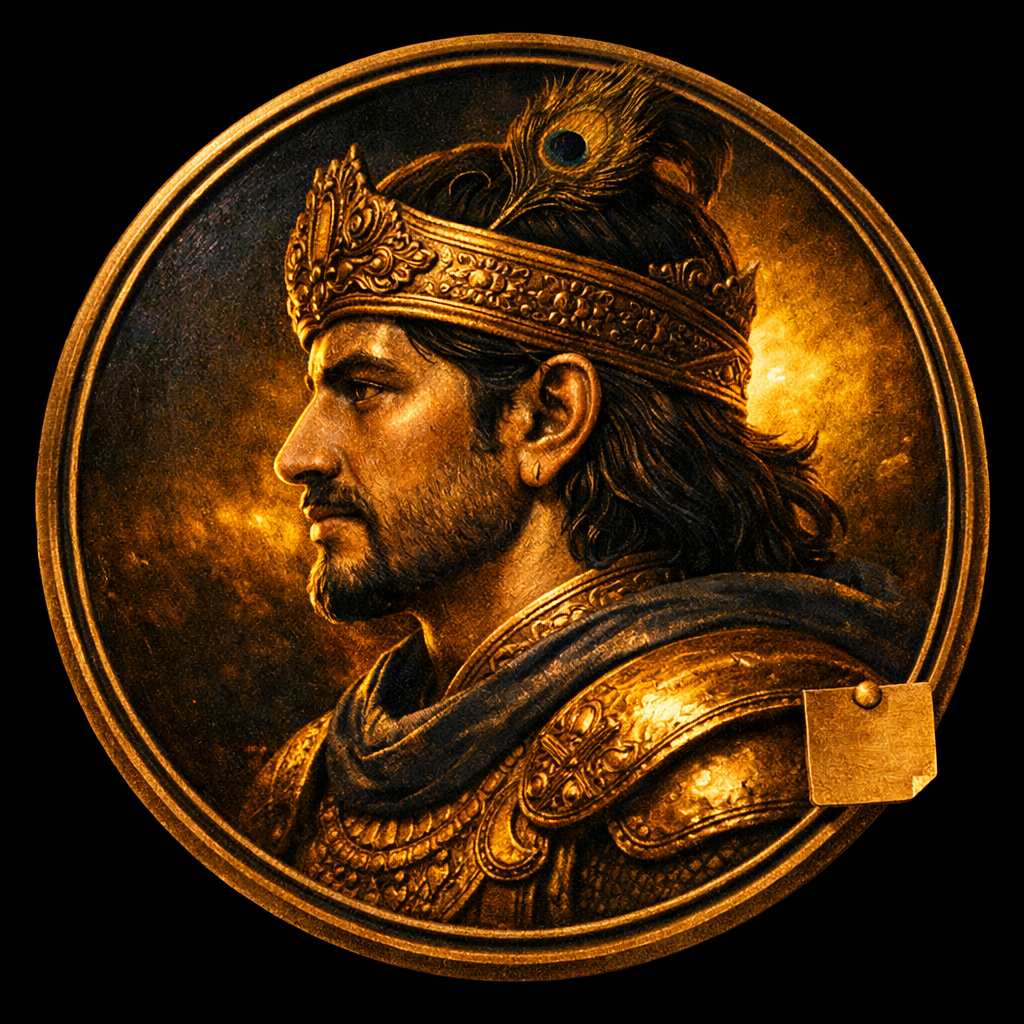
The battlefield was ready. The armies were aligned. Arjuna had trained his entire life for this moment.
Then he looked across the field — and saw his teachers, his cousins, his family. People he loved on the side he was about to fight. He lowered his bow. His hands shook. He told Krishna he could not do it.
What followed was not a battle. It was an 18-chapter dialogue on duty, clarity, and what it means to act without attachment to outcome. The Bhagavad Gita — one of the most studied texts in human history — was born in that moment of paralysis. Not despite the hesitation. Because of it.
Every project manager who has ever sat in front of a difficult decision — the honest status report, the escalation that will upset a sponsor, the team member who needs to be let go — has been Arjuna on that battlefield. The crisis is not that the decision is hard. The crisis is that you already know what it is.
Mythic Dossier
| Culture | Ancient Indian |
| Source | Mahabharata / Bhagavad Gita (~4th–2nd century BCE) — public domain |
| PM Competency | Ethical Decision-Making, Focus Under Pressure, Scope Clarity |
| ARC Connection | Rejuvenation |
The Legend in the Field

1. The Scene
Kurukshetra. Two armies. Arjuna rides his chariot between the lines, surveys both sides — and collapses. Not from fear of death. From the weight of clarity. He knows exactly what must be done, and exactly what it will cost. That knowledge is what breaks him.
Noise fades. The arrow flies.
Krishna does not tell him the battle will be easy. He does not remove the cost. He reframes the question entirely: the duty is not the outcome. The duty is the action — done with full commitment, without clinging to what comes after. Act because it is right. Not because it is safe.
Arjuna picks up his bow. The battle begins.
That moment — from paralysis to clarity to committed action — is one of the most compressed leadership arcs in human history. And it happens before a single arrow is fired.
2. What the Modern PM Learns
Arjuna’s crisis maps onto three dimensions that every project manager navigates, often simultaneously.
Ethical decision-making. The hardest decisions in project management are not the ones where you don’t know the answer. They are the ones where you do. Arjuna knew. The hesitation was not confusion — it was the cost of honesty. PMI’s Code of Ethics is built on this exact tension: responsibility, respect, fairness, honesty. None of them are comfortable. All of them are non-negotiable. Arjuna’s paralysis is not weakness. It is what ethical awareness looks like before it becomes action.
Focus under pressure. The battlefield is noise. Relationships, histories, loyalties, fears — all of it competes for Arjuna’s attention. Krishna’s teaching is a lesson in cognitive scope management: identify what is yours to act on, and release everything else. A project manager who cannot separate signal from noise does not lead — they react. Focus is not the absence of pressure. It is the discipline to act within it.
Scope clarity. Arjuna’s confusion was a scope problem. He had expanded his definition of “what this project is” to include the emotional cost of every stakeholder on both sides. Krishna brings him back to the essential scope statement: your role, your duty, your arrow. Everything else is outside the boundary. Scope creep is not only a planning failure — it is sometimes a moral failure, a confusion of what you are responsible for and what you are merely adjacent to.
3. The ARC Lens — Why Arjuna Is Rejuvenation
In the Mytholagile ARC Framework, Rejuvenation is the Prometheus principle: the eagle returns every day, the liver regenerates, and the change agent pays the price — but continues. It is not destruction. It is renewal through cost.
Arjuna is Rejuvenation because his transformation happens at the lowest point. He does not receive clarity before the crisis. He receives it inside it. The Bhagavad Gita is not a preparation for Kurukshetra. It is Kurukshetra. The wisdom emerges from the collapse, not before it.
This is the Prometheus Cycle: the most critical insight arrives at the moment of greatest pain. The project manager who has never been broken by a decision has never faced a real one. Arjuna’s regeneration is not the return of confidence. It is the replacement of comfort with clarity.
The Verdict
The Bhagavad Gita is 700 verses long. Arjuna’s transformation — from paralysis to committed action — takes 18 chapters. Most project managers do not get 18 chapters. They get a meeting, a deadline, and a sponsor waiting for an answer.
The lesson is not the length of the dialogue. The lesson is what Arjuna did when it ended: he picked up the bow. Not because the cost disappeared. Because the duty was clear.
Ethical leadership is not the absence of difficulty. It is the refusal to use difficulty as a reason to look away.
Noise fades. The arrow flies.
Carry the Legend
PM Legends · The Archive
Mythology did not record Arjuna because the battle was easy. It recorded him because he picked up the bow when it wasn’t. Subscribe to Mytholagile and follow the archive as it grows — one Legend at a time.
PM Legends is an ever-growing archive. The roster is open. The canon is alive. Next Legend coming soon.
Hat Sarsılmaz.
Leave a Reply