
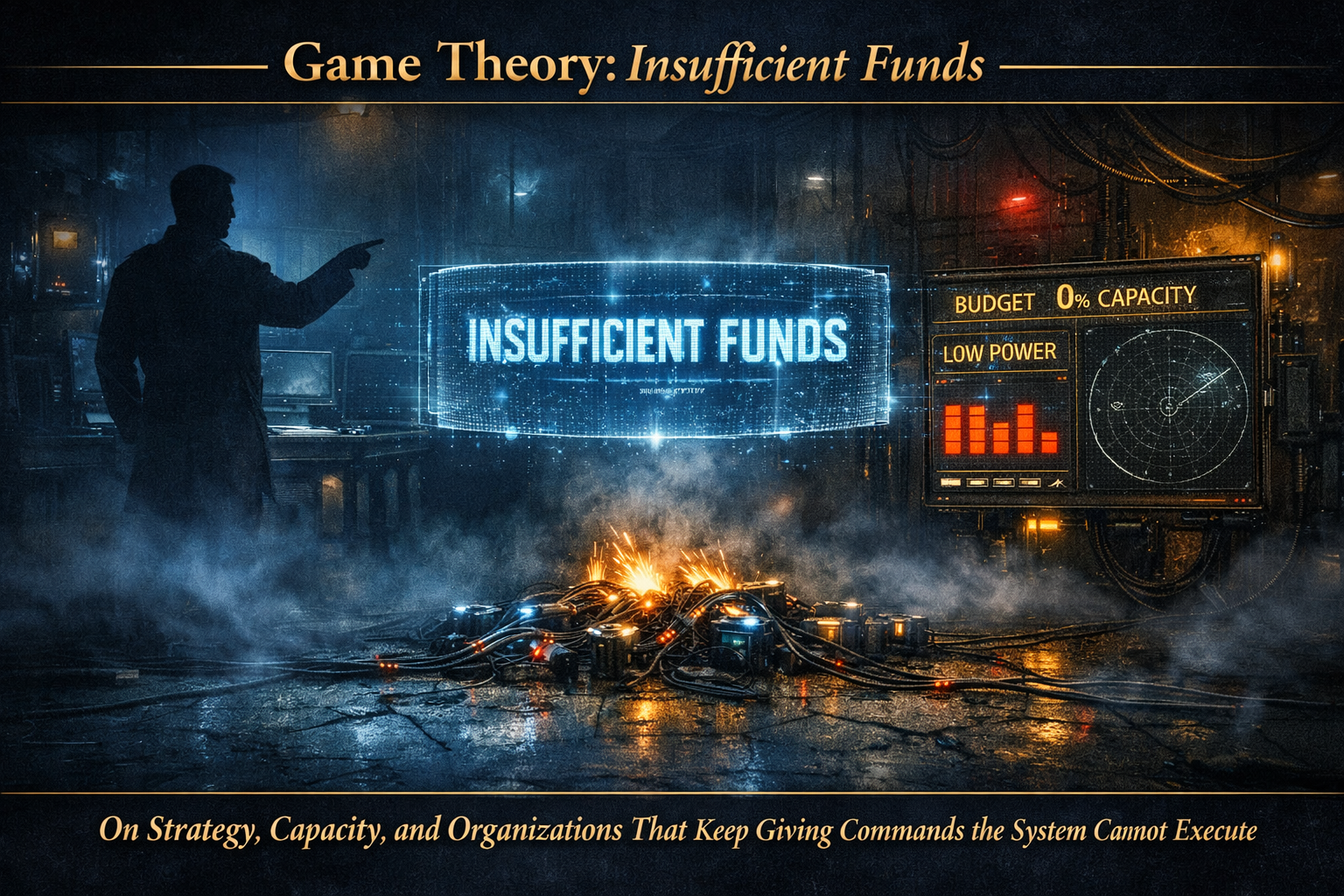
On Strategy, Capacity, and Organizations That Keep Giving Commands the System Cannot Execute
If you have ever played Command & Conquer: Red Alert, you know the voice.
Cold. Mechanical. Unimpressed.
“Insufficient funds.”
You click again.
Nothing happens.
You try to build the tank.
You try to place the defense.
You try to expand the base.
You try to answer the attack.
The strategy is clear.
The command is valid.
The urgency is real.
But the system refuses.
Not because the idea is wrong.
Not because the battlefield is quiet.
Not because the enemy is waiting.
Because the economy cannot carry the command.
The Organizational Echo
Organizations issue commands every day.
“Launch the AI initiative.”
“Scale agile across the enterprise.”
“Deliver faster.”
“Reduce cost while improving quality.”
“Modernize the platform.”
“Transform the customer experience.”
“Do more with less.”
The strategy is clear.
The command is valid.
The urgency is real.
And the system responds:
Insufficient funds.
Not always in those words. More often, the response sounds like this:
The team is already at capacity.
The architecture cannot support this yet.
The budget was approved but the headcount was not.
Leadership is aligned but the decision rights are unclear.
The roadmap is ready but the backlog is already full.
The initiative is funded but no one owns it.
Different words. Same message.
The command was given. The economy cannot execute it.
Strategy Does Not Execute Itself
Red Alert teaches a lesson that no strategy framework teaches cleanly:
Strategy does not execute itself. It needs an economy.
This sounds obvious. It is not practiced as though it were obvious.
Every organization has a command center — a leadership team, a strategic plan, a roadmap, a set of declared priorities. Commands emerge regularly. Initiatives are launched. Transformation programs are announced. Ambitious targets are set.
But the command center is not the same as the economy.
The economy is what actually executes the commands. It is the budget that is genuinely allocated, not just approved in a slide. It is the team capacity that is genuinely available, not borrowed from another delivery commitment. It is the technical foundation that is genuinely in place, not assumed to be adequate. It is the decision rights that are genuinely clear, not delegated so broadly that no one holds them.
Every organization has a command center. Few have the economy to execute its commands.
When the gap between the command center and the economy is small, execution is fast and confidence is high. When the gap is large, the organization enters a permanent condition of unfunded strategy — issuing commands that the system cannot execute, then wondering why delivery is slow, quality is declining, and teams are exhausted.
What “Funds” Actually Means
In Red Alert, insufficient funds means one thing: ore. Without ore, the construction queue stops.
In organizations, “funds” is a wider concept.
Budget is part of it. But budget alone does not constitute the economy of execution. Funding an initiative without funding the conditions of that initiative is one of the most common and costly errors in organizational strategy.
The full economy of execution includes:
Budget — the financial commitment, not the budget line in the deck.
Human capacity — not headcount on paper, but available attention after existing commitments are accounted for.
Technical capacity — the architecture, infrastructure, and codebase that the new initiative will have to run on or integrate with.
Decision rights — who can say yes, who can say no, and how fast those decisions can actually move.
Leadership attention — the scarcest organizational resource in most transformation programs. Attention is not infinite. When it is spread across too many priorities, none of them receives enough.
Organizational focus — the ability of the system to hold a direction long enough to build momentum. An organization that changes priorities every quarter is not adapting. It is perpetually resetting its own economy.
Learning capacity — the ability to absorb what execution reveals and adjust in response. Without this, the same mistakes are funded repeatedly.
A strategy without these is not a strategy. It is a command the system cannot execute.
Urgency Does Not Create Capacity
The most dangerous misunderstanding in organizational execution is this:
When something is declared urgent, people behave as though urgency creates capacity.
It does not.
Urgency reveals whether capacity exists.
In Red Alert, clicking the command button faster does not generate ore. The refinery is either running or it is not. The resource flow is either sufficient or it is not. Clicking harder produces nothing except the same cold response, arriving more frequently.
Organizations do this constantly.
The initiative is declared critical. The deadline is moved forward. The pressure increases. More reporting is added. More escalation paths are opened. More steering committees are convened to discuss why delivery is slow.
And delivery does not accelerate — because the team capacity has not changed, the technical debt has not been resolved, the decision rights have not been clarified, and the other twelve things declared equally critical last quarter are still in the queue.
Urgency does not create capacity. It only reveals whether capacity exists.
The honest question — the one most organizations avoid because it is uncomfortable — is not “why is this not delivered yet?” It is “what did we assume existed that does not actually exist?”
Low Power
Red Alert has a second warning that deserves equal attention.
Low power.
When a base draws more energy than the power plants can generate, everything slows down. Defenses weaken. Production queues drag. The radar dims. The base becomes vulnerable — not because it was attacked, but because it overextended itself.
This is not a battlefield failure. It is an infrastructure failure. Too much was switched on before the capacity to sustain it was built.
Organizations reach this state without noticing.
Too many projects running simultaneously. Too many declared priorities competing for the same attention. Too many transformation initiatives layered on top of normal operations. Too much work in progress, too little work completed.
The signals are familiar:
Teams that are always busy but rarely finish. Decisions that take weeks instead of hours. Quality that declines without anyone deciding to lower the bar. Leaders who are perpetually in meetings but rarely available to make decisions. Standups that report status without resolving blockers. A backlog that grows faster than it is emptied.
Low power is what happens when ambition consumes more energy than the organization can generate.
The response to low power in Red Alert is not to issue more commands. It is to build more power plants — or to switch off what the current infrastructure cannot sustain.
In organizations: before launching the next initiative, the honest question is whether the current infrastructure — people, systems, decisions, attention — can actually power it. If it cannot, the initiative will not fail because the idea was bad. It will fail because the base was already running at low power before the initiative was added.
Build the Refinery Before the Army
In Red Alert, military power follows economic power.
You cannot maintain a standing army without a functioning ore refinery. The trucks must collect. The refinery must process. The credits must flow. Without this, even the most sophisticated military force runs out of fuel.
Organizations invert this sequence constantly.
The army is built first — the team assembled, the project kicked off, the transformation program launched, the vendor selected, the implementation begun. And then, somewhere in delivery, the question that should have been answered before the first command was issued finally surfaces:
Where exactly is the funding coming from?
Who owns the decision if this conflicts with another priority?
What happens to BAU while this team is on the transformation?
What is the value model that sustains this after the initial investment?
These are refinery questions. They define the economy of execution. When they are asked late, the army is already in the field — and the refinery is still under construction.
Before you build the army, build the refinery.
In project terms: before the initiative is launched, the funding model, decision rights, team capacity, technical foundation, and value measurement system must be in place. Not planned. In place.
The army can be impressive. But if the refinery is not running, the army stalls in the field.
The Construction Yard and the Base
Red Alert’s most critical building is the Construction Yard.
Without it, nothing can be built. Destroy the Construction Yard, and the base stops being a base. It becomes a collection of existing structures, unable to expand, unable to repair, unable to adapt.
Every organization has a Construction Yard — the operational core that makes everything else possible. The delivery system. The governance model. The decision-making infrastructure. The teams that carry the actual work.
When transformation programs treat the Construction Yard as a given — as something that will simply absorb the new initiative on top of existing commitments — they are making the same mistake as a Red Alert player who launches an offensive without protecting the base.
The base has to function while the campaign runs.
This is one of the most persistent failure modes in organizational change: the transformation is designed in isolation from the operating system it must run on. The new is added without asking what the existing system can actually sustain.
A command center that destroys its own Construction Yard in pursuit of the campaign has no base left to return to.
ARC: The Anatomy of a Base
Every base that survives — in Red Alert and in organizations — carries three things simultaneously.
Core — The Construction Yard
The Construction Yard is not the most powerful building. It is the most foundational one. Without it, the base cannot rebuild, cannot adapt, cannot grow. The Core of an organization is the same: the operating identity, the delivery capability, the foundational systems that make everything else possible.
When transformation programs threaten the Construction Yard — when the change consumes so much capacity that the base can no longer function — the transformation will ultimately destroy what it was meant to improve.
What must remain operational, even as the base evolves?
Adaptation — The Radar
The radar does not fight. It reads. It detects. It surfaces what the battlefield is actually showing — not what the command center assumed it would show.
Adaptation is the organizational capacity to read what execution is actually revealing. Not what the plan said would happen. What is actually happening. And to adjust the command queue accordingly — without abandoning the campaign.
Adaptation is not changing the strategy every time a new signal appears. It is calibrating the execution in response to what the radar shows, while keeping the victory condition intact.
Rejuvenation — The Refinery
The refinery is the source of renewal. It converts raw material into the resource that sustains the base. Without it, the base depletes itself — drawing on reserves that do not replenish.
Rejuvenation is the organizational capacity to rebuild the resource base: to recover capacity, to restore focus, to generate the energy that the next campaign will require. A base that only deploys and never replenishes will eventually have nothing left to deploy.
A new campaign without a functioning refinery is a campaign that begins with the economy already in deficit.
Oracle. Labyrinth. Spartan Stand.
Three capabilities make the difference between a command center that leads and a command center that only commands.
Oracle detects unfunded commands. Before the command is issued, Oracle asks whether the economy exists to execute it. Not whether it sounds like a good strategy. Whether the funds, the capacity, the decision rights, the technical foundation are actually in place. Oracle is the discipline of honest resource assessment — applied before the commitment is made, not after the delivery fails.
Labyrinth maps the resource chain. Where is the ore? Where is it blocked? Which part of the base is drawing too much power? Where are the dependencies that no one has mapped? Labyrinth does not describe the organization you intend to build. It maps the actual resource flows, constraints, and bottlenecks of the organization you have — so the gap between the command and the capacity becomes visible before it becomes a crisis.
Spartan Stand protects the base from low power execution. Every strategic framework eventually meets Monday morning. The delivery meeting. The sprint review. The escalation call. Spartan Stand is the discipline of honest daily prioritization — asking which commands the economy can actually execute today, and refusing to pretend that urgency alone creates capacity.
Oracle detects unfunded commands. Labyrinth maps the resource chain. Spartan Stand protects the base from low power execution.
Without all three, the command center keeps clicking. The system keeps responding with the same cold, mechanical, unimpressed voice.
Insufficient funds.
Build the Economy
The command center is not the strategy.
The economy is the strategy.
Every backlog has a cost. Every roadmap has an economy. Every transformation has a power requirement. Every initiative assumes a resource base that either exists or does not.
The organizations that execute well are not the ones with the clearest strategy decks. They are the ones that have built the economy to carry their commands — that have laid the refinery before assembling the army, that have protected the Construction Yard while expanding the campaign, that have kept the power plants running before switching on the next initiative.
The command is valid.
The strategy is sound.
The urgency is real.
But none of that matters if the system cannot execute it.
Do not keep clicking the command.
Build the economy that can.
Hat Sarsılmaz.
But only if the base can power it.
Oracle detects unfunded commands. Labyrinth maps the resource chain. Spartan Stand protects the base from low power execution.
Mytholagile — Epic on the Outside. Lean on the Inside.
Leave a Reply