
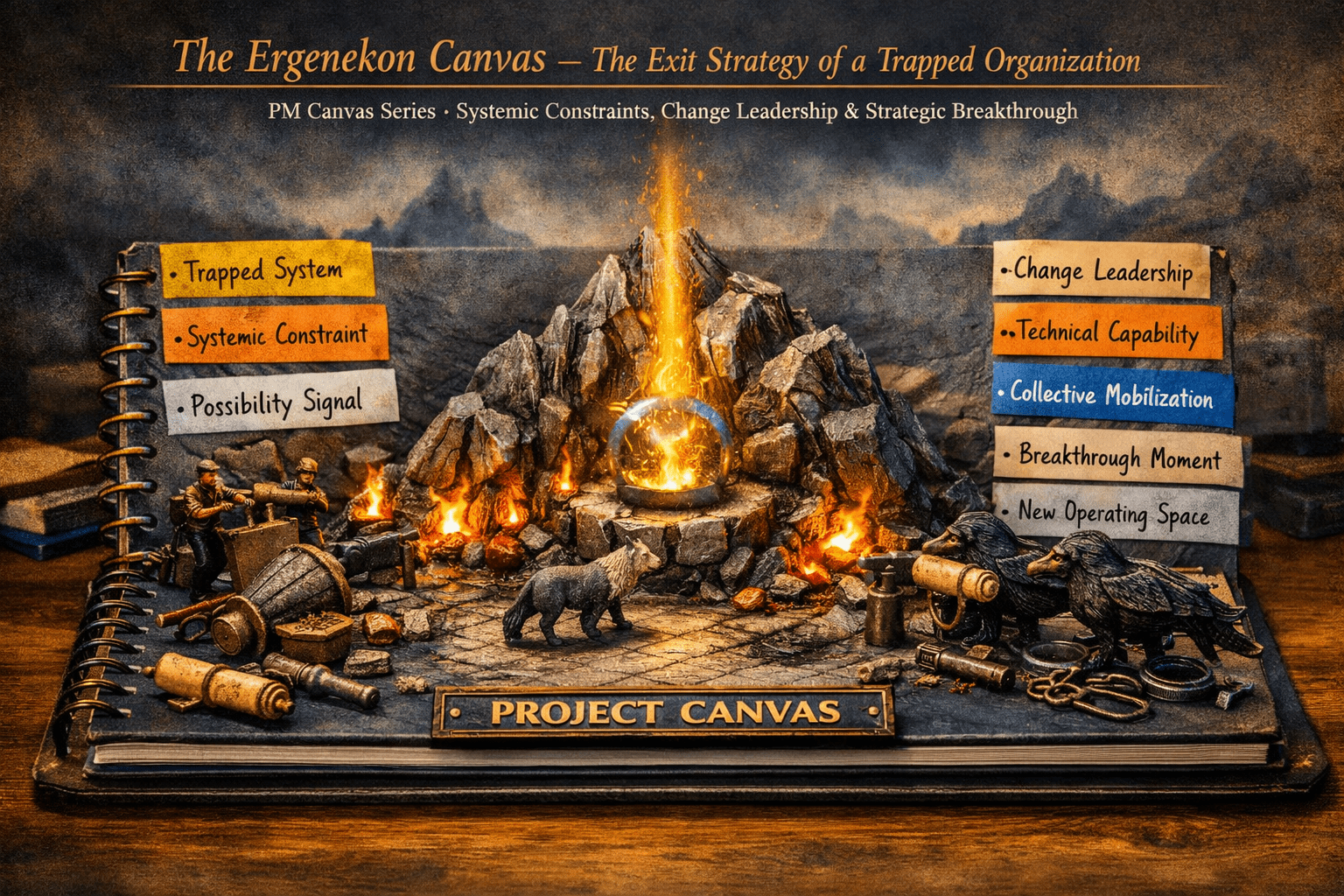
PM Canvas Series · Systemic Constraints, Change Leadership & Strategic Breakthrough
Some organizations do not need a better roadmap.
They need a mountain to be melted.
Because when the system is trapped, more planning does not create movement. Only constraint removal does.
Ergenekon is often remembered as a story of escape, survival, and rebirth. But through a project management lens, it is something sharper: a case of a trapped system whose internal capability no longer creates movement — because one systemic constraint has converted capacity into captivity.
The people are alive.
The skills remain.
The will has not disappeared.
But the system cannot move.
There is a valley.
There is a mountain.
And the mountain is made of iron.
Section I — The Trapped System
The Valley That Became a Prison
In the Turkic epic tradition, Ergenekon is the name of a valley — vast, fertile, sheltered. When the people fled the destruction of their world, Ergenekon received them. It was refuge. It was survival. For a time, it was enough.
But time changed the relationship between the people and the valley. What had been shelter became enclosure. The population grew. The land filled. The mountains that once protected now constrained. There was no path through the iron peak that sealed the valley’s edge. No route outward. No contact with the world beyond.
The people had not become weaker. Their knowledge had not eroded. Their craftsmen still worked, their warriors still trained, their elders still held memory. The system had not lost its capability.
It had lost its mobility.
A trapped system is not a weak system. It is a capable system that has lost the ability to move.
This is the distinction most organizational diagnostics miss. When a system stops moving — when projects stall, when transformation initiatives quietly die, when the same conversations repeat across quarters — the instinct is to ask: where did capability go? The Ergenekon diagnosis asks a different question: what single constraint is holding all the capability in place?
The people of Ergenekon were not failing. They were imprisoned by geography. For organisations, the geography is structural — a process, a dependency, a governance model, a technology constraint, a cultural assumption so embedded it has become invisible. The capability exists. The mountain stands between it and movement.
Section II — The Iron Mountain
The Constraint That Makes Everything Else Irrelevant
Ergenekon is not a story about finding an exit. It is a story about identifying the one constraint that makes every other capability irrelevant.
Inside the valley, optimisation continued. Life was organised. Work was done. The system functioned — within its enclosure. But no amount of internal improvement could produce external movement. More efficiency inside the valley did not open the mountain. Better planning inside the valley did not create a path through it.
The iron peak was not one problem among many. It was the problem — the systemic constraint from which all other limitations derived their power.
The Iron Mountain is the systemic constraint: the single barrier that converts capability into captivity.
Every system has a bottleneck. Not a collection of problems, but a single binding constraint through which all flow must pass. Strengthen anything else and nothing changes. Remove or elevate the constraint, and the entire system shifts.
In constraint thinking, improving anything other than the binding constraint may create activity, but not movement. Ergenekon makes that principle visible — not as theory, but as four hundred years of accumulated stillness inside a valley that had everything except an exit.
In organisations, the Iron Mountain appears in many forms. A legacy platform that prevents integration. A governance process that adds months to every decision. A dependency on a single team that touches every project. A cultural norm that prohibits honest escalation. A funding model that locks strategy into annual cycles.
People inside the valley usually know the mountain. They just call it by safer names: “governance,” “legacy system,” “approval flow,” “budget cycle,” “that dependency,” or simply “the way things work here.” The name changes. The mountain does not.
Most organizations build better processes inside the valley.
Very few ask what it would take to melt the mountain.
Section III — The Change Signal
The Wolf That Showed the Way
The breakthrough in Ergenekon did not begin with a plan. It began with a signal.
A wolf appeared — and moved toward the iron mountain. Not a rescuer. Not a solution. A direction. A demonstration that movement toward the constraint was possible.
The wolf is not decoration in this story. It is direction embodied.
In change leadership terms, the wolf is a possibility signal — the moment when what seemed fixed is shown to be approachable. The iron mountain has not yet moved. But someone has walked toward it. And that changes everything about the system’s relationship with the constraint.
Trapped systems do not suffer primarily from lack of capability. They suffer from the accumulated belief that the constraint is permanent. Every quarter that passes without movement reinforces the assumption: the mountain cannot be melted. This is how organizational inertia calcifies — not through weakness, but through repeated confirmation that the barrier cannot be crossed.
The possibility signal breaks that calcification. Not by removing the constraint — but by demonstrating that it can be approached, assessed, and potentially dissolved. This is the first act of change leadership: not the announcement of a transformation programme, but the visible movement toward the thing everyone has stopped looking at.
The wolf does not melt the mountain. It shows that the mountain can be approached.
That is enough to restart the system.
Sometimes the wolf is not a person. Sometimes it is a failed pilot that surfaced the real blocker. A frustrated engineer who documented what everyone already knew but nobody had written down. A customer complaint that could not be dismissed. A small team that proved the impossible was only politically impossible — until it wasn’t. The signal does not have to arrive from leadership. It has to arrive. And when it does, the system’s relationship with the constraint changes.
Section III · B — Change Leadership
The Four Disciplines of Breakthrough
The exit from Ergenekon was not a single heroic act. It was a sequence of disciplines — each one necessary, none sufficient alone.
I. The leader diagnoses the constraint, not the symptoms.
Organisations present symptoms: slow delivery, declining morale, repeated project failure, stakeholder disengagement. The Ergenekon lens does not ask “how do we improve these metrics?” It asks: what is the Iron Mountain behind them? Constraint diagnosis requires looking past the noise of performance data toward the single structural condition from which all the symptoms flow.
II. The leader makes the exit visible before it exists.
The wolf does not wait for the path to open before moving. The leader’s role is to demonstrate the direction of movement before the constraint has been removed — to make the possibility of exit real in people’s minds before it is real in the structure. Vision that does not name the mountain is not vision. It is comfort.
III. The leader organises collective capability toward the constraint.
The iron mountain was not melted by one person. It required craftsmen, fire, bellows, timing, rhythm, and the sustained energy of the community directed at a single point. Transformation that scatters effort across multiple initiatives simultaneously does not concentrate enough heat on any one constraint to dissolve it. Breakthrough requires focus — collective, coordinated, sustained.
IV. The leader makes the exit irreversible.
Leaving Ergenekon was not only a physical movement. It was the dissolution of a closed-system identity. The people did not exit the valley and return. The departure was a threshold — the transition from a system defined by its enclosure to a system defined by its movement. Transformation that does not redesign the system around its new operating space will drift back into the valley.
Section IV — The Canvas
The Ergenekon Canvas

The following canvas maps the Ergenekon story as a diagnostic and strategic framework. Each field is a question that every leader facing a trapped system must be able to answer — not in theory, but in the specific language of their organisation’s current constraint.
Trapped System
Core Question: Where is the system stuck?
Ergenekon Answer: Not where is it underperforming — but where has movement stopped entirely? The valley is not a place of failure. It is a place of arrested capability: competence without direction, energy without exit.
Systemic Constraint
Core Question: What is the Iron Mountain?
Ergenekon Answer: The single barrier converting capability into captivity. Not a list of problems — one binding constraint. If removing it would not unlock significant system-wide movement, it is not the mountain. Keep looking.
Possibility Signal
Core Question: What shows that the constraint can be approached?
Ergenekon Answer: The wolf does not melt the mountain. It moves toward it. What pilot, prototype, conversation, or leadership act demonstrates that movement toward the constraint is possible — and restores the system’s belief that the barrier is not permanent?
Change Leadership
Core Question: Who names the mountain and calls the collective toward it?
Ergenekon Answer: Constraint removal is a leadership decision before it is a technical one. Someone must be willing to say: this is not a wall to work around. This is the constraint we must transform. That naming — public, specific, consequential — is where change leadership begins.
Technical Capability
Core Question: What skill or knowledge can dissolve the constraint?
Ergenekon Answer: The iron mountain was melted by people who knew how to work metal and fire. Constraint removal requires specific capability — not general improvement. What is the precise technical, analytical, or organisational competence the system needs, applied at the point of the constraint, to dissolve it?
Collective Mobilization
Core Question: Who must move together — and at what rhythm?
Ergenekon Answer: Craftsmen, fire, bellows, timing. Breakthrough is not a solo act. It requires the coordination of multiple capabilities toward a single point, sustained over time. Which teams, disciplines, and stakeholders must be aligned — not generally, but specifically toward the constraint?
Breakthrough Moment
Core Question: How will constraint removal be recognised?
Ergenekon Answer: The mountain’s melting is a threshold — a before and after. What is the specific, observable signal that the constraint has been removed? Without a defined breakthrough moment, transformation becomes a permanent state of “working on it.”
New Operating Space
Core Question: What changes when the system exits the valley?
Ergenekon Answer: Exit is not the end. It is the beginning of a different system — one no longer defined by the constraint that shaped it. What new operating model, governance, structure, or rhythm must be established to ensure the system does not recreate the valley in new terrain?
Section V — The Verdict
Are You Managing Symptoms, or Melting the Mountain?
Here is the diagnostic most transformation programmes avoid: is the organisation working on the constraint, or around it?
Inside Ergenekon, life continued. Systems were built. Processes were refined. Culture evolved. The valley was, by many measures, a functioning organisation. What it could not do was move beyond the boundary the iron mountain imposed.
Most transformation efforts do the same thing. They improve what is already inside the enclosure. Better dashboards. More structured retrospectives. Clearer OKRs. Faster sprints. These are not wrong. They are simply insufficient when the constraint has not been named — because optimising inside the valley does not open the mountain.
The dashboard may be green. The valley may still be closed.
The most dangerous moment in a trapped system is when the internal optimisation is working well enough that the mountain stops being named.
Comfort inside the valley is not the same as movement. A system that has learned to live efficiently with its constraint is not a system that has solved it. It is a system that has made peace with captivity.
The Ergenekon question is not “how are we performing?” It is “what are we still unable to do — and what is the single constraint making that impossibility permanent?”
This is where the ARC Framework arrives — not as a model imposed on Ergenekon, but as a recognition of what the story already carries.
A — Adaptation
Principle: The valley is left behind.
Ergenekon Expression: Adaptation here is not incremental adjustment. It is the surrender of the closed-system identity — the willingness to stop optimising the enclosure and direct collective energy toward the constraint. The system that adapts does not improve the valley. It exits it.
R — Rejuvenation
Principle: The mountain is melted.
Ergenekon Expression: Rejuvenation is not recovery from exhaustion. It is the restoration of movement — the reactivation of capability that was always present but blocked. The melting of the mountain is Rejuvenation made literal: collective energy, concentrated and sustained, dissolving the constraint that had converted capacity into captivity.
C — Core
Principle: The people remember why they must move.
Ergenekon Expression: Through decades inside Ergenekon, something was preserved: the memory of what the people were before the enclosure, and the knowledge of what they were capable of beyond it. Core is not nostalgia. It is the identity that survives the constraint — the purpose that makes the difficult work of constraint removal worth undertaking.
Adaptation leaves the valley.
Rejuvenation melts the mountain.
Core remembers why the people must move.
Section VI — What Is Your Organisation’s Iron Mountain?
Not every blocker deserves a transformation. But every trapped system has one constraint that must be named before movement can return.
The naming is not the solution. It is the precondition. Before the craftsmen can be organised, before the fire can be built, before collective energy can be directed — the mountain must be identified. Specifically. Structurally. Without the softening language that turns systemic constraints into “areas for improvement.”
What is the single constraint in your system that, if removed, would unlock movement that no amount of internal optimisation can currently produce?
Who in your organisation is willing to name it — not as a challenge area, not as a known risk, but as the Iron Mountain it actually is?
And what would it take to concentrate enough collective heat, at that precise point, to begin the melting?
That is the Ergenekon Canvas.
Not a roadmap for the valley. A framework for identifying the mountain — and deciding, with full awareness of the cost, to melt it.
Ergenekon melts the mountain. Another legend begins when movement must become order.
Mytholagile is not here to train you. It is here to remind you. Because mythology already wrote the playbook.
The line holds.
Hat Sarsılmaz.
Leave a Reply