
Mytholagile White Paper — Framework Validation · Historical Evidence
Kongō Gumi: An ARC Anatomy Across 1,428 Years
Historical Validation and a Warning on Organizational Balance
Introduction: What Does Not Kill a Company?
AD 578. Three carpenters from the Korean kingdom of Baekje are invited to Japan. Their mission: to build Shitennō-ji, Japan’s first Buddhist temple. One of the three masters — recorded in sources as Shigemitsu or Shigetsu Kongō1 — does not merely build a temple that year. He builds an institution.
That institution will be called Kongō Gumi. It will stand for 1,428 years.
To make that number tangible: Kongō Gumi was founded six centuries before the Ottoman Empire. It survived two world wars, Japan’s forced conversion away from Buddhism, and forty successive generations of family leadership. In the 2004–2005 period, it still employed over a hundred people and generated approximately $60–70 million in annual revenue.2
In 2006, it ceased to exist as an independent family business.
This is not an ordinary corporate failure. It surfaces the purest question in organizational lifecycle thinking: Are the dynamics that sustain an institution for centuries different from those that eventually stop it? Or are they the same?
The Mytholagile ARC Framework — Adaptation, Rejuvenation, Core — is not the sum of three separate virtues. It is the maintenance of balance between three forces. Kongō Gumi embodies that balance across fourteen centuries, then documents its collapse. This is why Kongō Gumi serves as both a historical validation and a sharp warning for ARC: Core can survive. But if the Adaptation and Rejuvenation architecture that carries Core collapses, the organization loses its independence.

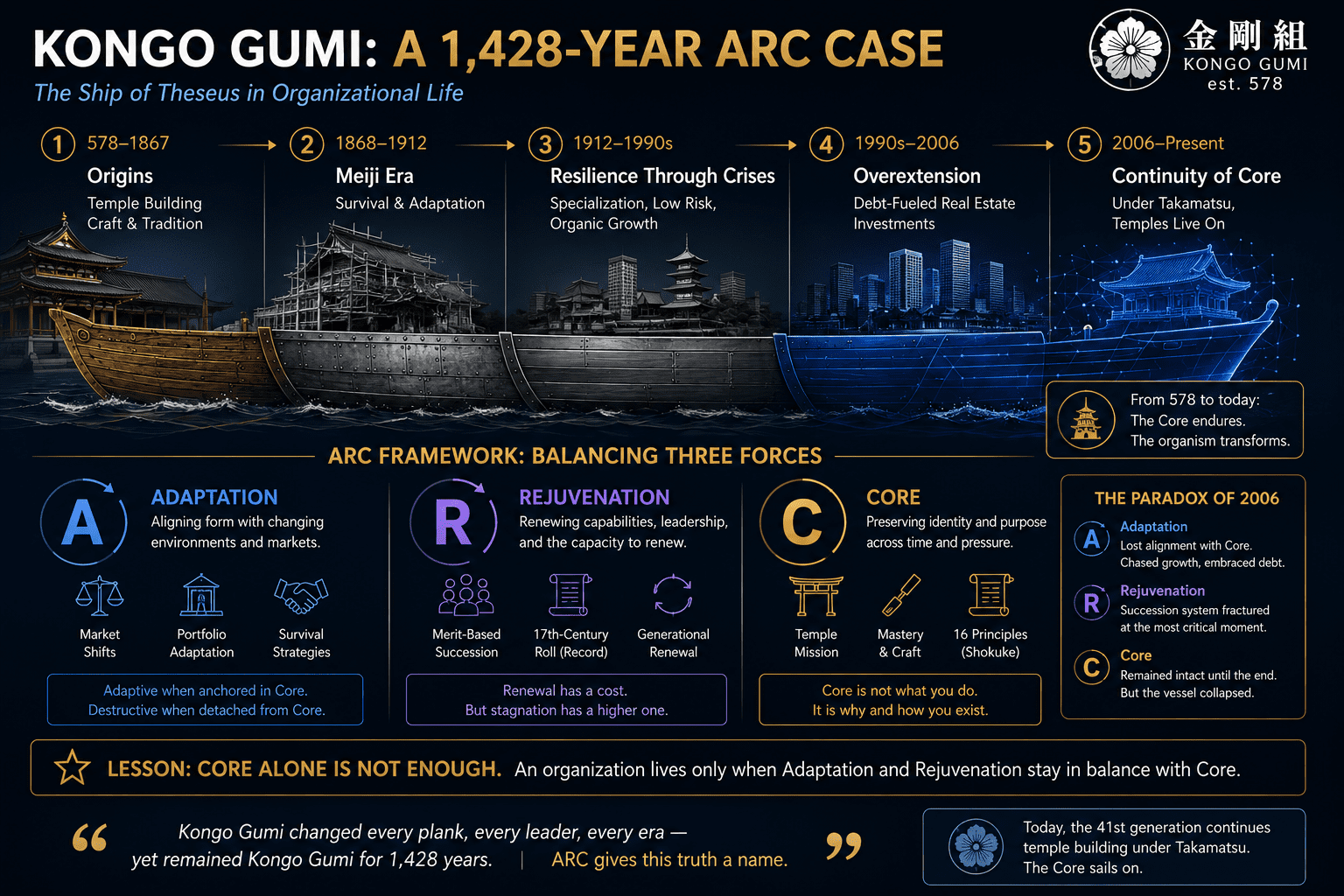
Figure 1 — Kongō Gumi: Generations Changed, Mastery Remained
The visual reads Kongō Gumi’s five historical periods through the metaphor of Theseus’s Ship. Each period represents a different form of the vessel — but the ship remains a ship. From an ARC perspective, the visual summarizes how Core was carried across fourteen centuries, and how Adaptation and Rejuvenation made that continuity possible. However, what the visual deliberately does not show is equally central to this analysis: the three dimensions did not hold in balance through 2006. The collapse of the Adaptation and Rejuvenation architecture ended the organization’s independence — even as Core itself remained intact. The visual documents the era in which ARC functioned. Not the moment it broke. That distinction is the analytical core of this case.
I. Core: What Did Not Change Across Fourteen Centuries
In the ARC Framework, Core defines the identity constant an organization must protect against total change pressure. It is not a logo. It is not a mission statement. Core determines not only what an institution knows, but what it considers worth knowing — and that determination becomes the reference point for every strategic decision.
Kongō Gumi’s Core was unambiguous: temple construction. The preservation of Buddhist architectural tradition. The transmission of woodworking mastery from one generation to the next.
This definition served as the fixed navigational reference for fourteen centuries. Economies changed. Political powers changed. Japan’s religious policy changed dramatically. Kongō Gumi built temples.
The translation of Core into operational practice is visible in three concrete mechanisms:
1. Shokuke kokoroe no koto — “Family Knowledge of the Trade”
During the Meiji period, the company’s 32nd leader, Yoshisada Kongō, distilled the firm’s accumulated institutional wisdom into sixteen written precepts. These were not the financial metrics or operational procedures a Western management consultant might expect. Alongside quality control and customer relations, the precepts addressed how to dress, how to drink in moderation, and how to treat others with respect. What appears at first to be a cultural protocol is, in ARC terms, the behavioral codification of Core — the written record of the moment institutional identity was translated into conduct.
From a Mytholagile perspective, this document demonstrates how organizational memory is protected against periodic pressure. Because Core is not only about what is done. It is equally about how it is done and who one is while doing it.
2. The Ritual Transmission of Craft
A new Kongō Gumi worker underwent ten years of apprenticeship, followed by ten years of master-level training. By modern human resources standards, this timeline appears inefficient. But viewed through the ARC lens, this is not a question of efficiency — it is the process of learning Core’s language. Mastery was not the transfer of knowledge. It was the transfer of identity.
3. The Kumi Structure
Workers were organized into kumi — competing workgroups that challenged each other to produce the finest results. The reward was not money. It was the recognition of excellence. This structure reinforces collective identity before individual motivation. The winning kumi did not receive more compensation. It earned the honor of representing Core’s standard.
The Ship of Theseus metaphor finds its clearest historical expression here. Kongō Gumi replaced hundreds of planks across the centuries — leaders changed, workers changed, techniques evolved. But the ship remained a ship. Because Core was held.
II. Adaptation: Speaking the Language of Every Age
If Core is an organization’s reason for existence, Adaptation is the capacity to transform form in order to sustain that reason against the pressures of each era. But not all Adaptation carries equal value. A controlled expansion around Core and an opportunistic move disconnected from Core share a name — but not a result. Kongō Gumi’s history demonstrates this distinction through two contrasting episodes.
The Meiji Period (1868–1912): Adaptation Around Core
Japan’s Meiji reforms brought active suppression of Buddhism. Tens of thousands of Buddhist temples were destroyed. Kongō Gumi’s near-exclusive client base — Buddhist religious institutions — was systematically dismantled. This was not merely market contraction. It was a state-level threat to the organization’s reason for existence.
Kongō Gumi did not abandon its identity. It survived. By expanding into office and residential construction projects, it diversified its revenue base while retaining its craft expertise. This was not a departure from Core. It was an expansion of the perimeter in order to protect Core. Temple construction was under pressure; construction mastery was carried into new forms. A Heraclitean reading: the river is the same river, but the water has changed. Form adapted. Essence held.
The 1980s–1990s: Adaptation Disconnected from Core
During Japan’s asset bubble of the 1980s, Kongō Gumi moved into debt-financed real estate investments. This move was structurally different from the Meiji adaptation. The earlier expansion had remained within the orbit of construction expertise — close to Core. The real estate gamble carried no organic connection to Core; it was a response to the appeal of financial leverage.
When the asset bubble burst in 1992–1993, property values fell and debt collateral weakened. A long-term structural decline in temple construction revenue made the burden heavier still.3 Kongō Gumi could no longer carry this weight as an independent family business.
The ARC distinction is precise: Every Adaptation must first consult its Core reference. Adaptation that disconnects from Core does not grow the organization. It hollows it.
III. Rejuvenation: The Prometheus Cycle and the Ritual of Leadership Transfer
Rejuvenation is the most complex dimension of the ARC Framework — because Rejuvenation is not simply “renewal.” It encompasses the transformation of the change agent itself, and the cost that transformation carries.
Mytholagile names this dynamic the Prometheus Cycle: when Prometheus brought fire to humanity, he transformed the world — and paid the price of that transformation personally. Every genuine organizational renewal carries a similar structure. Finding the new fire is not enough. The body, the role, and the responsibility that will carry the fire must be redefined. Kongō Gumi institutionalized this redefinition across fourteen centuries with remarkable precision.
Competency-Based Succession — Not an Anomaly, But Doctrine
The standard family business model transfers leadership to the primary male heir. Kongō Gumi suspended this model by design. Masakazu Kongō, the 40th and final independent leader of the firm, identified leadership selection flexibility as the central factor in the company’s longevity.
Kongō Gumi passed leadership not to the eldest son, but to the most capable family member. When no suitable male heir was available, a son-in-law would take the Kongō name and assume leadership — or a daughter would step into the role. The company’s 38th leader, Yoshie Kongō, was a woman. The 39th was a son-in-law who had taken the family name upon joining.4
This system is the institutional codification of Rejuvenation. Each generation transferred leadership not by biological sequence, but by competency sequence. The distinction may appear minor. Applied consistently across fourteen centuries, it becomes the most powerful mechanism of organizational adaptation.
The 17th-Century Scroll: The Physical Embodiment of Institutional Memory
A three-meter scroll from the 17th century traces forty generations of family leadership back to 578 AD. This scroll is not a document. It is a transfer instrument. Each new leader who received it also received the physical continuity of institutional identity — and accepted the obligation to one day hand it to the next generation.
In the Prometheus Cycle, this obligation is central: Rejuvenation does not only transform the institution. It transforms the one who transforms it. Each leadership transition at Kongō Gumi was a moment in which both the institution’s identity and the leader’s identity were renegotiated.
Compared to the Ise Protocol5, a similarity and a difference emerge. Both are built on cyclical renewal ritual. But at Ise, the form of the ritual is non-negotiable — what is renewed is fixed. At Kongō Gumi, the content of the ritual (leadership selection criteria) was flexible; the form (family continuity and temple identity) was fixed. These are two different but equally valid expressions of how ARC manages the boundary between Core and Adaptation.
IV. 2006: The Moment the Balance Broke
In January 2006, Kongō Gumi lost its status as an independent family business. Its assets were acquired by Takamatsu Construction Group, and the firm continued operations as a wholly owned subsidiary.6
Adaptation disconnected from Core. The real estate move of the 1980s violated the internal logic of every previous adaptation. All prior adaptations had preserved construction expertise and a low risk appetite. This time, the growth trap took hold: mistaking a temporary financial opportunity for structural strategy.
The Rejuvenation architecture broke in the final generation. Disputes and debt pressure within the family’s leadership transition rendered decision-making mechanisms ineffective. The succession system that had functioned without failure for forty generations failed precisely when it was needed most.
Core survived — but survival was not enough.
This is Kongō Gumi’s most instructive paradox. The company preserved its temple-building identity to the very end. On the day of its dissolution as an independent firm, it was still constructing temples. Core did not collapse. But the financial and leadership skeleton that carried Core did.
The ARC Framework holds a sharp warning here: Protecting Core is not the same as protecting the organization. When the three dimensions fail to operate simultaneously and in balance, even the strongest Core can lose its independence along with the structure that carries it.
V. Framework Validation: What ARC Learns from Kongō Gumi
1. The behavioral codification of Core is directly correlated with organizational longevity.
What justified Kongō Gumi’s existence across fourteen centuries was not being “a good company.” Technical mastery in temple construction and the cultural meaning it carried — these defined Core. A defined Core provided a reference point in every period of crisis. The Shokuke kokoroe no koto is Core translated into behavior: not an abstract vision, but a living protocol.
2. The direction of Adaptation is measured by its distance from Core.
The Meiji adaptation and the 1980s adaptation cannot be described with the same word. One was a controlled expansion within the orbit of construction expertise — close to Core. The other was a financial move with no organic connection to Core. ARC does not only ask “what changed” when evaluating Adaptation. It asks “how far is it from Core.”
3. The Rejuvenation mechanism must outlive the founder’s vision.
Kongō Gumi’s competency-based succession system is the fourteen-century proof of this principle. When the system broke — in a single generation — the organization’s independence ended. The Prometheus Cycle takes its purest form here: when the renewal mechanism can no longer renew itself, an outside force takes over.
Closing: Knowledge Is Not Invented. It Is Excavated.
Kongō Gumi’s story is not an archaeological question about a company’s survival strategy. It is an archaeological question about what an organization is.
Mytholagile’s epistemological position is this: Knowledge is not invented. It is excavated. The ARC Framework is not a model produced by modern management literature — it is the naming of a logic that was already operating inside mythological and historical life cycles long before it was given a name.
Kongō Gumi lived that logic from 578 to 2006. It held all three dimensions in different forms across different eras. And it ultimately lost its independence through the breakdown of the balance between them.
But under the roof of Takamatsu, the 41st generation of the Kongō family is still building temples.
Core did not die. The organism changed.
ARC names that distinction.
Hat Sarsılmaz.
Notes
1 The founder’s name appears in two forms across sources: Shigemitsu Kongō (Takamatsu Construction Group’s official account) and Shigetsu Kongō (Works That Work magazine). Both sources agree on the founding year and temple context; the variation likely reflects transliteration differences.
2 Revenue figures for Kongō Gumi’s final period are cited in sources as ¥7.5 billion (approximately $70 million) for the year 2005. Some sources reference 2004 as the base year; accordingly, the formulation “2004–2005 period” is used throughout.
3 Based on accounts from the Long Now Foundation and Works That Work magazine, the two primary causes of the firm’s collapse were: (a) the decline in collateral value following debt-financed real estate investments made during the 1980s asset bubble, and (b) a long-term structural decline in temple construction revenue.
4 Works That Work magazine (Irene Herrera, 2014): the 39th president, Toshitaka Kongō, was a son-in-law who took the family name. Female leadership reference: ReGENERATION Partners analysis notes that the 38th leader was Masakazu Kongō’s grandmother.
5 See Mytholagile PM Canvas #4 — “The Ise Protocol”: on the Japanese temple renewal ritual. For comparative reading, refer to the relevant Canvas section.
6 Kongō Gumi continues to operate today as a wholly owned subsidiary of Takamatsu Construction Group, maintaining its specialization in temple and shrine architecture.
Leave a Reply