
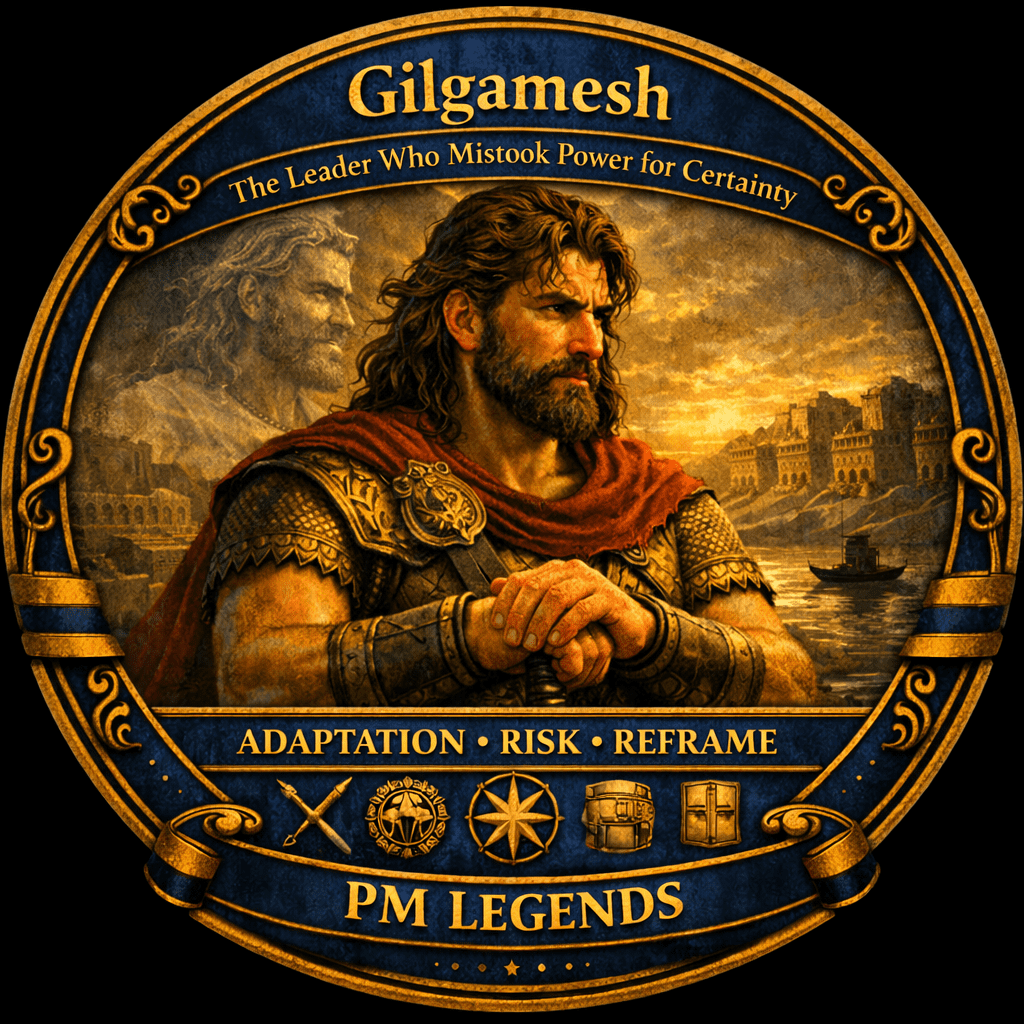
He was the strongest king in the world. He had built the walls of Uruk. He had fought every battle worth fighting and won. He had no equal in the field and no rival in the city.
Then Enkidu died.
Not in battle. Not from an enemy Gilgamesh could have fought or a threat he could have planned against. Enkidu died because the gods decided he would die, and there was nothing Gilgamesh could do about it. For the first time in his life, he was in the presence of a variable he could not manage.
His first mistake was not failing to see the risk. His first mistake was treating every uncertainty as a task.
Mythic Dossier
| Culture | Ancient Mesopotamian |
| Source | One of the oldest surviving epic traditions in world literature |
| PM Competency | Risk & Uncertainty, Navigating the Unknown, Leadership Reframing |
| ARC Connection | Adaptation |
The Legend in the Field
1. The Scene
Gilgamesh ruled Uruk. He was two-thirds divine, one-third human, which meant he understood power completely and mortality not at all. He and Enkidu became the kind of companions that great projects produce: two people whose combined capacity exceeds what either could do alone, who push each other further than comfort would allow.
When Enkidu died, Gilgamesh did not grieve and continue. He left. He abandoned the city, the administration, the walls he had built, and set out to find the secret of eternal life. Because if there was a solution to death, he would find it. That was how he approached every problem. Identify the objective. Apply sufficient force. Achieve the outcome.

The journey took him across the Waters of Death to Utnapishtim, the one mortal who had survived the flood and been granted immortality by the gods. Gilgamesh arrived with his question. Utnapishtim gave him two tests. He failed both.
On the way back, he found the Plant of Youth at the bottom of the sea. He brought it to the surface. A snake stole it while he slept.
He returned to Uruk with nothing. Looked at the walls he had built. And for the first time, understood what they meant.
The walls of Uruk were there before him. They will be there after. He built them not knowing this. He returned knowing nothing else.
2. What the Modern PM Learns
Gilgamesh’s crisis is not unusual in project management. It is, in fact, the defining crisis of any leader who has spent long enough succeeding.
The control illusion. Gilgamesh was not incompetent. He was extraordinarily capable. And that is precisely the problem. Leaders who have consistently delivered results develop an implicit model of the world: effort produces outcomes, resources solve problems, authority resolves ambiguity. This model works until it doesn’t. The moment it breaks is always a version of Enkidu dying: a loss, a disruption, a variable that arrives outside the scope of what any plan could have anticipated. The instinct of a powerful leader in that moment is to do more, move faster, reach further. Gilgamesh walked to the edge of the known world. It was the only response he knew.
Risk that cannot be mitigated. Modern project management gives leaders several responses to risk: avoid it, reduce it, transfer it, or accept it. Gilgamesh had never needed the fourth option. His entire career had been built on the first three. What the journey to Utnapishtim taught him, slowly, through failure, is that some variables exist entirely outside the system the leader controls. A project manager who has never genuinely accepted an unresolvable risk has not yet led a real project. The question is not whether that moment will come. The question is whether the leader will still be standing when it does.
The reframing of value. Siduri, the tavern keeper Gilgamesh met on the road, told him to stop. Eat well. Let the child on your lap be filled with joy. Look at the one who holds your hand. That is what is given to you. Gilgamesh did not stop. But he heard it. And when he returned to Uruk empty-handed, what he saw in the walls was not his failure to find immortality. He saw something that would outlast him, and understood that this was the only kind of permanence a mortal leader could build.
This is the hidden form of benefits realization: sometimes the original objective fails, but the journey produces a more durable value than the objective itself.
3. The ARC Lens — Why Gilgamesh Is Adaptation
In the Mytholagile ARC Framework, Adaptation is Heraclitus’s river: you cannot step into the same river twice. The water changes. The river remains. But the key insight is not that change happens. It is that a leader who does not adapt to change will eventually be standing at the riverbank, insisting the water should have stayed still.
Gilgamesh is Adaptation because his transformation operates on three levels simultaneously.
The external world changes. Enkidu dies. The stable configuration of Gilgamesh’s reality is disrupted by something he did not cause and cannot reverse. This is the trigger. Not a challenge to be solved, but a condition to be absorbed.
The internal model changes. Gilgamesh arrives at Utnapishtim expecting to solve death the way he solved everything else: through sufficient determination and the right information. What he discovers is that the framework itself is wrong. The objective was never achievable. The entire journey was built on a category error. A leader who can recognize this, who can abandon the wrong framework mid-journey rather than double down, is a leader who can adapt.
The system understanding changes. When Gilgamesh returns to Uruk and looks at the walls, he does not see a consolation prize. He sees the only kind of work that actually persists: the thing you build that does not require you to be alive for it to matter. This is not resignation. It is a recalibration of what success means after the original definition has failed.
Adaptation is not the ability to respond to change. It is the ability to rebuild your understanding of value after the original version no longer holds.
The Verdict
He set out to defeat death. He returned having learned to build.
Most project leaders will not face a quest this mythic in scale. But every project leader will eventually face a version of Enkidu dying: a loss that is real, irreversible, and outside the scope of any plan they could have made. The instinct in that moment is to do what Gilgamesh did first. Apply more force. Search harder. Refuse to accept the result.
The lesson is not to give up. The lesson is to recognize when the objective has become the wrong objective.
He failed the quest. He completed the transformation.
A leader who can return from an unwinnable situation and look at what they actually built, not what they intended to build but what is actually standing, and find meaning in it, has demonstrated the rarest capacity in project management. Not control. Not certainty. Adaptation.
Because the leader who survives uncertainty is not the one who controls the river. It is the one who learns how to return changed and move with the flow.
The walls of Uruk were there before him. They will be there after. He built them not knowing this. He returned knowing nothing else.
Carry the Legend
PM Legends · The Archive
Mythology did not record Gilgamesh because the quest succeeded. It recorded him because he returned. Subscribe to Mytholagile and follow the archive as it grows — one Legend at a time.
PM Legends is an ever-growing archive. The roster is open. The canon is alive. Next Legend coming soon.
Hat Sarsılmaz.
Leave a Reply