
Foundation Series · Article 2 of 4 · 8 min read
You Are Already Running Experiments. You Just Don’t Call Them That.
Every product launch is a hypothesis. Every sprint is a test. Every failed stakeholder alignment is a data point.
Modern management loves the language of experimentation. A/B tests. Minimum viable products. Fail fast, learn faster. These are not just methodologies; they are a philosophy, a belief that error is not failure but feedback.
And that belief is correct. Thomas Edison’s path to the lightbulb was not a straight line; it was thousands of wrong materials before tungsten. Amazon runs hundreds of controlled experiments simultaneously. Google has baked experimentation into its founding DNA. The scientific method itself assumes you will be wrong and treats that as the engine of progress.
Trial and error works. History has proved it. But it is also the most expensive way to learn.
The Smarter Move Has Always Been Obvious
Otto von Bismarck, a man who spent his career navigating impossible coalitions and building an empire from fragments, is credited with a line project managers rarely encounter in their certification prep: “Only a fool learns from his own mistakes. The wise man learns from the mistakes of others.”
This is not a motivational poster. It is an operational principle.
The investor Charlie Munger spent decades building what he called a “latticework of mental models”: frameworks drawn from physics, psychology, history, biology, economics. His argument was simple: the world’s problems do not respect disciplinary boundaries, so your solutions cannot either.
Nassim Taleb goes further in Antifragile: systems that cannot learn from the errors of others are not just inefficient; they are fragile. They break when they should bend. They are surprised by events that history already rehearsed.
Across fields and centuries, the pattern is consistent: the highest-leverage learning does not come from your own experiments, but from studying the experiments successful and catastrophic of those who came before you.
Which raises an uncomfortable question for anyone who manages projects, leads teams, or navigates organizational change:
What is the largest, most field-tested knowledge base in human history?
A Moment for the Manifesto
Before we answer that, it is worth pausing on something that deserves more than a passing reference.
In February 2001, seventeen software practitioners gathered at a ski resort in Snowbird, Utah. They were not academics. They were builders who had spent years watching waterfall processes produce the wrong things, slowly, expensively, and without apology. They had had enough. Two days of conversation produced four values and twelve principles sixty-eight words that mattered.
The Agile Manifesto did not invent agility. It named it. It gave the industry language for something practitioners already knew instinctively: that working software matters more than comprehensive documentation, that customer collaboration matters more than contract negotiation, that responding to change matters more than following a plan.
It compressed decades of software-development pain into a framework that fit on a single page.
And then something unexpected happened.
The principles escaped the repository.
Healthcare adopted them. Education systems restructured around them. Manufacturing, defense, finance, government Agile showed up everywhere, and it worked. Not because the Manifesto’s authors designed it for these domains, but because the underlying logic was deeper than software. It was human. It was about how intelligent groups navigate uncertainty. And uncertainty is not a software problem. It is a condition of existence.
That universality did not go unnoticed. Gradually, as the evidence accumulated across industries and decades, a new question surfaced:
If these principles work everywhere today, how far back do they actually go?
The Excavation
That question initiated what I can only describe as a conceptual archaeological excavation.
Not a tour of management literature. Not a survey of modern frameworks. A dig into mythology, philosophy, military doctrine, ancient statecraft, and the narrative traditions of civilizations that had no project management software, no Scrum ceremonies, no Gantt charts. Civilizations that nevertheless built empires, navigated catastrophic uncertainty, and adapted to conditions that would collapse a modern organization in a quarter.
What we found was not metaphor. It was architecture.
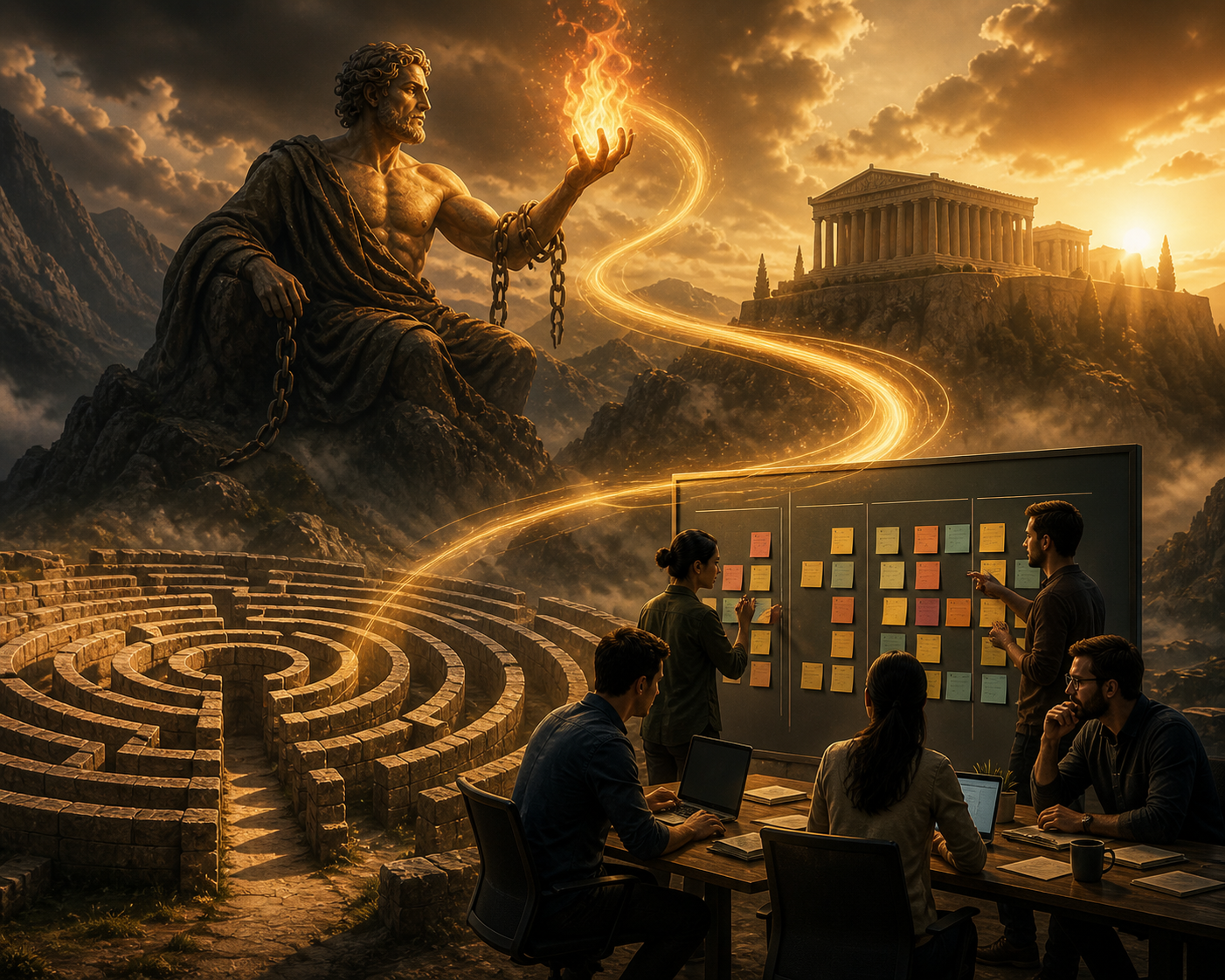
The Spartan phalanx was not just a military formation; it was a model of cross-functional team alignment, where every shield depended on the one beside it. Odysseus steering between Scylla and Charybdis was not just a story about a sea monster; it was a stakeholder-management case study in constrained decision-making under dual-threat conditions. Prometheus stealing fire from the gods was not just a tale of rebellion; it was the earliest recorded account of the pioneer cost the price paid by those who deliver transformative value before the organization is ready to receive it.
These are not decorative parallels. They are compressed operational intelligence, encoded in narrative form because narrative is how human memory works. Long before slide decks. Long before certification frameworks.
Mythology, properly understood, is not the opposite of rational management. It is the original knowledge-management system.
What the Excavation Produced
Mytholagile emerged from that excavation.
Not as a mythology course dressed in Agile clothing. Not as a rebranding exercise. As a synthesis: the 49 process groups of PMI’s project-management framework, the 12 principles of the Agile Manifesto, and the archetypal wisdom of 36+ mythological traditions integrated into a single, coherent operating doctrine for leaders navigating uncertainty.
The governing principle is not complexity. It is compression. Every abstract framework becomes a story. Every story becomes a decision-making shortcut. Every shortcut becomes instinct which is what you need when the sprint collapses, the stakeholder panics, and there is no time to consult the methodology.
This is why the tagline is not aspirational. It is structural:
Epic on the Outside. Lean on the Inside.
The mythology carries the weight. The methodology does the work. They are not in tension. They are the same thing, viewed from different angles.
What This Means in Practice
If you are preparing for PMP certification, Mytholagile does not replace the PMBOK. It makes it memorable. The 49 processes stop being an exam burden and become a cast of characters, each with a story, a failure mode, and an unforgettable lesson.
If you are a practicing project manager, Mytholagile gives your team a shared language that operates faster than a framework. You do not need to re-explain the risk-management process. You invoke the Prometheus Cycle. The room knows what that means. Alignment accelerates.
If you are a leader navigating organizational change, Mytholagile gives you a diagnostic lens. Every transformation has a mythological signature a pattern the excavation has already mapped. You are rarely in a situation that history has not already survived. The question is whether you know where to look.
The Question That Started This
The Agile Manifesto was written because seventeen people were honest enough to ask: what do we actually believe not what does the methodology say, but what have we learned from watching projects succeed and fail?
Mytholagile begins with a different version of the same question:
What have civilizations learned, across thousands of years and every domain of human endeavor, about leading through uncertainty? And how do we start?
The excavation has answers. The first thing it surfaced was not a weapon. It was a shield.
Hat Sarsılmaz. The line holds.
Next in the Foundation Series: 3- Shield Before Spear — Mytholagile’s first archetype.
Leave a Reply