
Foundation Series · Article 3 of 4 · 7 min read
Why Do Fast Teams Break Under Pressure?
Speed is not the problem. Most teams have speed. They ship, iterate, and hit velocity metrics that look impressive in sprint reviews.
And then pressure arrives. A restructuring, a budget cut, a pivot. And the formation collapses.
The difference between a fast team and a resilient team is not output. It is protection. Fast teams optimise for the spear. Resilient teams build the shield first.
This is not just a metaphor. It is an operating principle, one the excavation surfaced from the oldest recorded models of high-performance teams in history.
The Spear-First Trap
Modern management is built spear-first. Velocity. Delivery. Output per sprint. Key results. The frameworks reward what is produced, not what is protected.
Execution matters. The spear matters. But velocity without protection converts directly into fragility.
Most teams optimise for output, not formation. They move fast until something hits them from the side. A stakeholder who was never aligned. A dependency that was never mapped. A team member who was carrying the formation alone and finally dropped the shield. Then everything stops. Not because they were not fast enough. Because they were not protected enough.
Agile understood this. Sustainable pace, team safety, continuous collaboration. These are not productivity features. They are protection mechanisms. But in practice, they are the first things cut when pressure rises.
The excavation asked why. And it found the answer in a formation that has not been improved upon in two thousand years.
What the Excavation Found
The Spartan phalanx was not history’s most effective military formation because the Spartans were the strongest warriors. It was effective because of a single structural principle:
A shield does not protect the one who holds it.
It protects the one next to him.
The formation is the system.
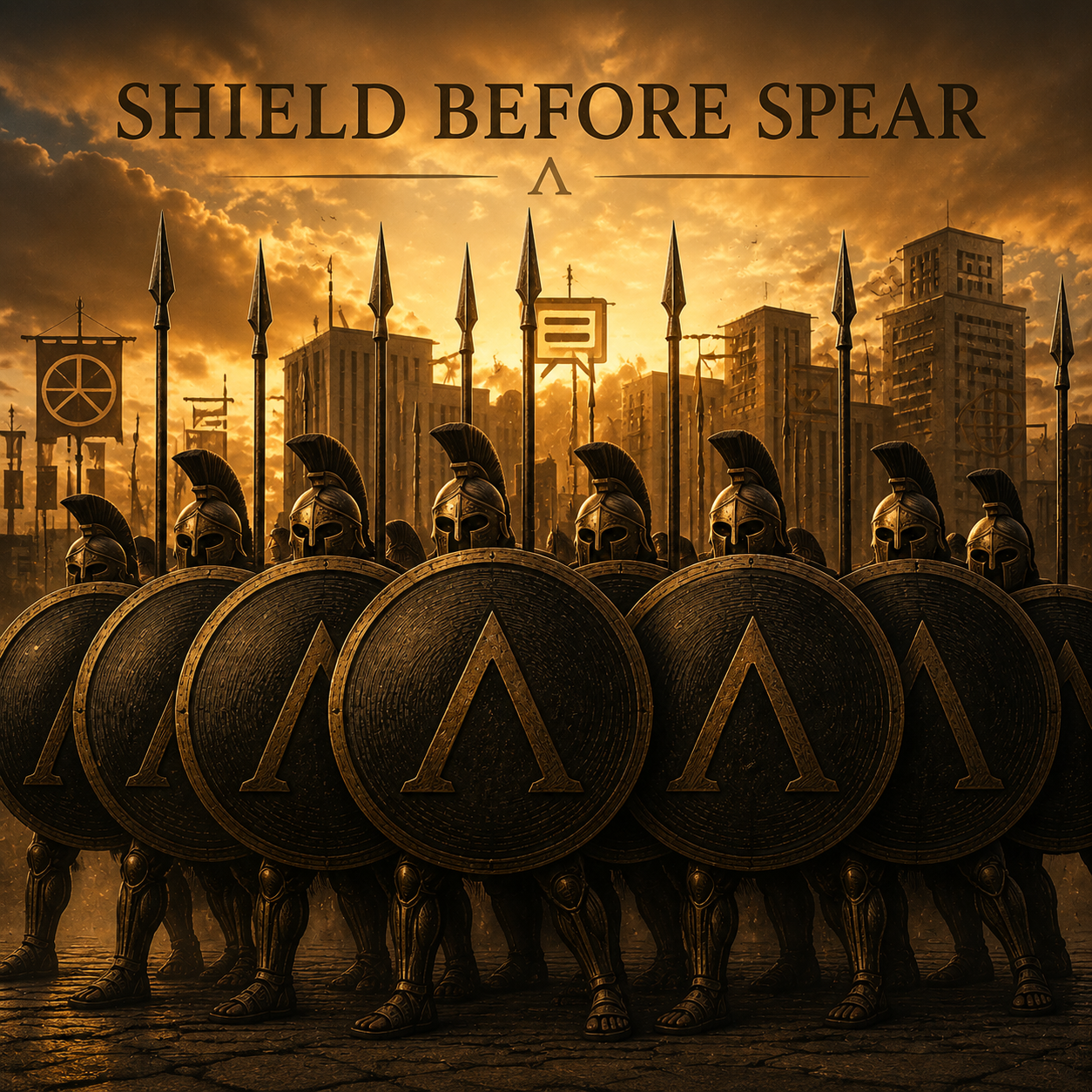
Every shield overlapped with the one beside it. Every soldier’s exposed side was covered by his neighbour. The formation created collective protection that no individual could create alone. Remove one shield and the line opens. Not just for the soldier who dropped it, but for everyone beside him.
This is not ancient military history. This is organisational architecture. The strongest teams are not collections of strong individuals. They are formations where each person’s exposure is covered by the person beside them, and no one carries the line alone.
If you have seen Zack Snyder’s 300, you have already seen the phalanx. The scene at Thermopylae: three hundred Spartans holding a narrow pass against an army of thousands. That is not cinema’s exaggeration of history. It is history. And what made it possible was not individual strength. Watch the formation. Shields locked, overlapping, each soldier’s left side covered by the man beside him. The moment a single shield drops, the line opens. Not for one man. For all of them. That is the system.
The Polemarchos
Every formation needs a point where alignment becomes action.
In the phalanx, this was the Polemarchos. Not a general shouting orders from the rear, but a leader standing in the front line. First shield. First exposure. First to hold.
The Polemarchos is not a title. It is not a rank. It is a behaviour pattern.
The distinction matters:
A manager controls. A Polemarchos aligns.
A manager optimises individual output. A Polemarchos maintains formation integrity.
A manager moves up when pressure rises. A Polemarchos moves forward.
The Polemarchos filters the noise that would break the formation before it reaches the team. Holds the line facing the external pressure. Identifies where the shields are weakest and adjusts before the gap opens.
In Zack Snyder’s 300, Leonidas does not watch the battle from the rear. He holds the front. That is not drama. That is the operating model.
This is Mytholagile’s first archetype. Not because it is the most dramatic, but because without it, no other archetype can function. You cannot move without formation. You cannot form without a shield. You cannot shield without someone willing to stand in front.
Shield Before Spear in Practice
No tools here. No templates. Three questions, because the formation either exists or it does not, and you already know which one is true for your team.
Is your team protected from external noise, or directly exposed to it?
When a senior stakeholder panics, a deadline shifts, or a scope change lands without context: does it hit the team raw, or does something absorb it first?
Where is the weakest shield in your formation?
Not the weakest performer. The weakest point of coverage. The person carrying more than their share because the shield beside them is missing or misaligned.
When pressure rises, does leadership move forward, or upward?
This is the test. Not in calm sprints. In the moment when something breaks. Which direction does the leader move?
What Comes Next
A shield holds the line. Direction chooses where the line goes. Movement is what turns survival into progress.
The formation is built. The next question is not how to protect. It is how to move.
Hat Sarsılmaz. The line holds.
Next in the Foundation Series: 4- Chronos vs. Kairos: The Two Types of Time Every Leader Must Master
Leave a Reply